
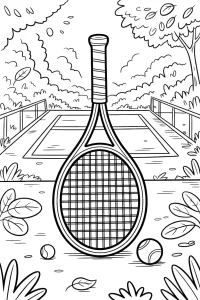
Boy with Tennis Racket on Court
Download printable coloring page PDF

Tennis has something magical about it. The ball bounces off the court and suddenly it’s loud and cheerful. The racket swings through the air, and the net divides the court into two worlds. This category brings those emotions to paper. In just a moment, your home can turn into a small tournament.
In tennis pictures, you’ll often see a racket and a ball. Next to them, there’s a net and the simple lines of the court. Sometimes there’s a cap or a wristband. This helps children quickly recognize the sport.
In this subcategory, you’ll find both calm and dynamic scenes. Some show the setup for a serve. Others depict a long rally and a sprint for the ball. You’ll also see medals, trophies, and smiles after a win. Each coloring page can be the start of a short story.
Tennis drawings love backgrounds. You can add the sun, clouds, or a light breeze. You can draw stands and flags. Children immediately feel the atmosphere of a match. Additionally, they learn to plan space.
Many illustrations have space for simple additions. Just draw a bag for rackets. You can add a water bottle and a towel. You can also draw a basket of balls. These small details spark imagination.
If you’re collecting different themes, check out the Printable Coloring Pages database. From there, it’s easy to go to the Sports section. It’s also worth visiting the main page of Kolorowanka.FUN. Ideas for any weather await in one place.
Tennis pairs well with other sports. Children can compare a tennis ball with a soccer ball. They can also see other courts and outfits. Then, the Soccer and Basketball subcategories come in handy.
A court is a field with lines where players run. The net divides the court into two halves. A racket is used to hit the ball. A serve is the first hit in a rally.
A game is a small part of the match. A set is longer and consists of games. Out means the ball landed outside the line. A tie-break is a short playoff for points.
You don’t need to know everything at once. Just pick two words a day. Then, children look for them in the picture. This makes learning light and enjoyable.
For younger children, simple outlines are best. A large racket offers plenty of space for color. The ball is easy to fill in. The court lines help practice pencil control.
In preschool, speed and success matter. So choose pictures with fewer details. Also, leave some time for free doodling. They are part of development.
For older kids, details matter. They can color the racket’s weave and the grip’s texture. They can also draw their own logo on the shirt. It’s great patience training. Plus, it gives a sense of agency.
Older children often enjoy “by eye” tasks. Suggest shading under the shoes. Let them add shine to the ball. Then, the coloring page looks like a sports poster.
In a group, pictures that can be divided into roles work well. One child colors the player. Another does the background and stands. A third refines the court lines. As a result, a collaborative work emerges.
If a child gets discouraged quickly, start with a short session. Sometimes 10 minutes is enough. Then you can return to the picture. If needed, check out the guide How to Encourage Kids to Color?.
Tennis has simple shapes but offers a lot of room for fun. The court can be green, blue, or clay-colored. It depends on the surface you choose. This way, one coloring page can look different each time.
It’s worth starting with the question: “What court is it today?” Then you choose colors together. The child learns to make decisions. Meanwhile, they practice naming colors.
A hard court often associates with a blue center. The sides can be green. Leave the lines white for clarity. You can add a subtle shadow near the net.
A clay court likes orange and warm brown. Just a few darker streaks. It mimics shoe marks and slides. The child immediately sees movement.
A grass court is several shades of green. Draw short strokes like blades. Then make lighter stripes. This effect is simple yet looks great.
Court lines have their logic. They are straight and even. It’s a good opportunity for pre-writing exercises. The child confidently guides the pencil.
A tennis ball is often yellow and very bright. However, you can choose your own color. Some kids prefer pink or lime. That’s okay too.
Draw a small shine on the ball. Just a white dot. The ball then looks like it’s in motion. It’s a quick trick.
A racket can have a metal frame or be colorful. The grip looks good in two shades. One makes the base. The other mimics the overgrip.
If the drawing shows the weave, color it gently. Leave some gaps. Then the “eyes” will be light. And the picture won’t become heavy.
If you want to play with mood, use tips from the text Color Psychology in Children’s Drawings. It helps choose colors consciously. However, always leave the child freedom.
A tennis outfit can be simple. It can also be very bold. A child can create their own set. Let them choose a shirt and shorts. Let them add striped socks.
A headband and wristband are great areas for patterns. You can make dots. You can make zigzags. Even a small motif brings a lot of joy.
Sports shoes are also important. You can give them color and draw laces. The child then practices small elements. This helps in daily activities.
Start with the largest areas. The court and background go first. Then color the outfit. Leave the net and details for last.
Add two shadow lines under the player’s feet. The picture immediately “stands” on the ground. It’s a simple trick. Kids like this effect.
Mark the ball’s flight direction. Just two thin lines. The ball then looks faster. And the scene becomes more sporty.
You can use an unusual technique. Glue paper strips to the net. Press a small tissue ball into the ball. You’ll find such ideas in the guide Discover 5 Unusual Coloring Techniques.
Tennis teaches patience. It also teaches dealing with mistakes. This is evident even in coloring. Sometimes the pencil goes outside the line. You can calmly correct it then.
It’s worth talking about emotions in simple words. “I’m angry because it didn’t work.” “I’m proud because I finished.” Such sentences help children. Moreover, they build confidence.
You can add a small ritual. First, three deep breaths. Then choose colors. Finally, a short water break. This plan calms and organizes play.
In tennis, points are often counted as 15, 30, and 40. It sounds strange, so kids quickly remember it.
The word “love” means zero score in tennis. This way, you can practice English while playing.
Tennis is played on different surfaces, each looking different. There are grass, clay, and hard courts.
A good choice of theme makes it easier to start. One day, a child wants to quickly color a ball. Another day, they prefer the whole court. It’s good to have several options.
Tennis coloring pages exercise hand precision and smooth wrist movement. Children learn to stay within the lines. They train focus because court lines are regular. They learn to plan because the background comes first, then details. Moreover, they build patience when refining small elements. As a result, their confidence grows. There’s also a proud: “I can finish.”
Tennis coloring pages work well in many places. At home, they provide a calm moment after preschool. At school, they can be part of sports lessons. In the common room, they help gather a group at one table.
On the go, it’s worth taking a few prints in a folder. On a train or in a waiting room, time passes faster. The child has a clear task. You have less stress. Moreover, it’s easy to pack a few crayons.
If you plan a sports day, print a series of works. Each participant can color the same pattern. Then you’ll compare outfits and courts. It’s a nice and safe competition.
On a rainy afternoon, ready-made games come in handy. Check out the guide 8 Activities with Coloring Pages for Rainy Days. Many ideas can be adapted to a tennis theme. Just a bit of imagination is needed.
After coloring, make a home scoreboard. Just a sheet of paper and a marker. Then play “mini tennis” with a balloon. The balloon flies slowly, so it’s safe. You can play referee and player. Such a play teaches rules and sportsmanship. Another idea is “color hunting.” The parent says a color, and the child finds it in the picture. Finally, take a photo of the work and give it a title. If you want more inspiration, check out Printable Coloring Pages – Sports Emotions. You can also look at the guide Therapeutic Coloring Pages for Kids. There you’ll find ideas for calmness. This makes it easier to return to the table.
All materials in this category are free. You can download and print each coloring page at home. It’s a convenient solution for a quick afternoon. All you need is a printer and a few sheets of paper. You can also print two copies of one pattern.
A4 paper works well for printing. For markers, choose a thicker sheet. Then the ink won’t bleed through. Crayons like technical paper. Pastels look best on slightly textured paper.
It’s worth keeping finished works. You can put them in a folder or binder. The child will see progress after a few weeks. And if there are leftover pictures, make keepsakes from them. Tips from the article Don’t Throw It Away! 7 Creative Ideas will help.




You are browsing the Tennis category. Looking for more? See other coloring pages in Sports or browse all printable coloring pages.