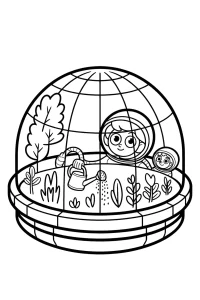
Plants in a Space Glass Dome
Download printable coloring page PDF

Imagine floating above Earth, watching the blue planet slowly drift beneath your feet, with the solar panels of a massive space station gleaming beside you. With our designs, each coloring page can transport children – and adults, because coloring bridges generations – into the world of brave astronauts, intricate research modules, and magical microgravity. This colorful adventure educates, fascinates, and relaxes. Both little ones and older kids will find a mission out of this world, and parents will appreciate that the illustrations are free and ready to print.
In short, a moving home in orbit sparks our eternal curiosity. Moreover, witnessing a sunrise every ninety minutes is an experience hard to overvalue. Astronauts observe phenomena inaccessible from the planet’s surface, and we – through photos, videos, and coloring pages – can accompany them in their daily lives. Furthermore, children eagerly discover that ordinary items, like a toothbrush, take on new meanings in space. The fact that everything floats makes even mundane tasks look spectacular.
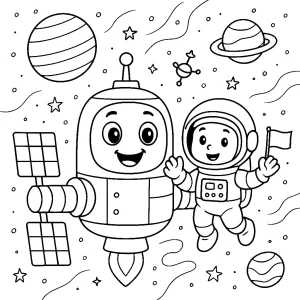
When it comes to cosmic “homes,” the Soviet Salyut 1 appeared first in 1971. Then, in the 80s, the legendary Mir station reached orbit, eventually burning up in the atmosphere in 2001. Today, the largest structure of this kind is the International Space Station (ISS), while China is developing its modular Tiangong. Which research programs help us know more about the human body, materials, and astrobiology today? These facilities provide answers, signaling hope that one day we will venture further – to the Moon, Mars, and even beyond the Solar System!
Fun Fact 1: The first Salyut 1 crew spent only 23 days in orbit, but the mission’s findings accelerated the construction of subsequent stations.
Fun Fact 2: The ISS features the Cupola module with seven windows, allowing astronauts to take incredible photos of Earth.
Fun Fact 3: The Japanese Kibo segment contains the largest “space veranda,” where experiments are directly exposed to the vacuum.
In the long run, working in orbit requires strict organization. Laboratory modules are equipped with retractable research stations, and pressurized airlocks allow astronauts to perform spacewalks. Although the space kitchen doesn’t offer luxuries, the menu includes dishes from various countries, packed in lightweight, hermetically sealed bags. A warning beep signals every pressure change. Meanwhile, in microgravity, sleep resembles levitation – walks turn into swimming, and everyday items detach from walls, adding a charming chaos.
Which experiments are pushing science forward? During long-term programs, researchers observe both tissue cultures and fluid behavior in weightlessness. As a result, medicines for bone diseases or cancers may develop faster. Additionally, astronomers, using the station, place instruments beyond atmospheric interference, increasing measurement precision. Nevertheless, the human factor is also fascinating: how does the psyche cope with isolation, and can humans live in space for years?
A coloring page is more than just paper and crayons. With dynamic astronaut figures and realistic modules, we teach children precise observation. As a result, they improve hand-eye coordination, patience, and a sense of aesthetics. More importantly, the theme of orbiting bases stimulates scientific curiosity. A child asks questions: “How does a solar panel work?”, “Why doesn’t the station fall?” – and a parent has the chance for a creative conversation. Ultimately, through play, children discover that science and art can coexist.
Benefits for children: Coloring space stations teaches precision, but also relaxes. This helps children better manage stress, improve fine motor skills, and expand vocabulary with technical terms like “docking” or “microgravity”.
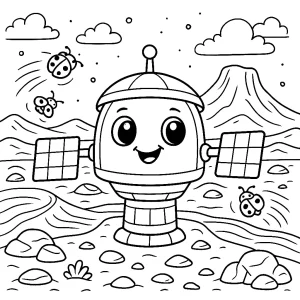
More importantly, each coloring page can be turned into a STEM project. While younger kids focus on colors, older children will happily build a cardboard model of the modules. This way, it’s easy to combine art with science. Meanwhile, encourage kids to experiment with materials: fluorescent paints can create a night sky view, while glitter can reflect the shine of solar panels. Additionally, laminating the finished drawing gives you a durable desk mat – a keepsake from an orbital adventure.
Fun ideas: Occasionally, turn off the lights, illuminate the coloring pages with a UV flashlight, and pretend to take a night walk in an EVA suit. You can also record a “mission journal,” describing coloring progress, and then compare how details change with each session.
For convenience, remember that each coloring page is available in PDF format, ready to print on a home printer. This way, you can prepare a creative lesson in seconds – just click and print. Discover the joy of coloring our free designs to build a bridge between fantasy and science with your child at no cost.
Our coloring pages can be downloaded at any time, without registration, and the line quality ensures that even fine liners don’t bleed through to the other side of the paper. This keeps your home archive of works looking neat. We encourage sharing your results on social media – the hashtag #SpaceColoringPage allows young artists to meet peers from other parts of the world.


You are browsing the Space Stations category. Looking for more? See other coloring pages in Space or browse all printable coloring pages.