
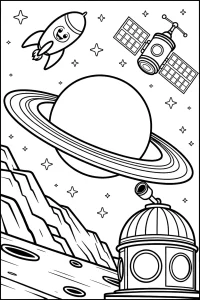
Planet with Rocket and Satellite
Download printable coloring page PDF

Imagine your child embarking on a galactic mission without leaving home. A coloring page featuring majestic planets, Saturn’s swirling rings, and Mars’ golden deserts can transport young explorers straight onto a spaceship. From the first stroke of the crayon, little astronauts learn observation, patience, and precision while also expanding their imagination. That’s why we offer carefully designed printable coloring pages, each sheet available for free download. With them, the cosmic adventure becomes real, and family afternoons are filled with color.
Above all, the diversity of solar system themes is captivating. Children learn not only about the eight main planets but also moons, dwarf planets, and the asteroid belt. At the same time, planetary coloring pages teach spatial orientation – to truly understand the size of orbits, kids must replicate proportions. As a result, learning astronomy seamlessly combines with developing manual skills. Let’s also note that during coloring, children learn color selection. Quick decisions, like whether Venus will be orange or cream, build confidence. It’s a simple activity, yet it develops a wide range of skills.
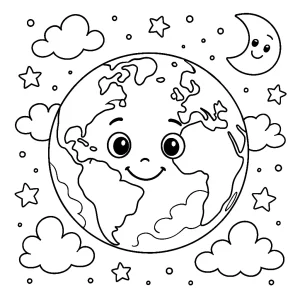
Moreover, coloring together facilitates conversations about science. A parent can talk about, as I mentioned, Jupiter’s tiny moon while the child listens, simultaneously guiding the crayon. At the same time, there is a natural integration of scientific and artistic knowledge. Thanks to this, children gain a broader perspective than what a typical textbook offers. Printable coloring pages ensure that cosmic facts remain in memory longer.
Pluto, though demoted to a dwarf planet, still fascinates scientists with its ice-nitrogen mountains. Its surface temperature is below –220 °C. In short, it’s one of the coldest regions in the Solar System. Moreover, a day on Pluto lasts over six Earth days, making its sunrises exceptionally rare. Try to imagine such a dawn.
Saturn is the undisputed king of rings. In reality, the rings consist mainly of ice chunks and dust – their total mass doesn’t exceed that of a larger moon. Nevertheless, the system is vast, stretching hundreds of thousands of kilometers. Looking at the planet’s illustration in the coloring page, a child can, in other words, realize how minimal gravity can maintain such an impressive structure. It inspires questions about physics.
Mars, on the other hand, is called the Red Planet for a reason. Iron oxides in its soil give it a characteristic hue. The tallest volcano in the Solar System, Olympus Mons, rises about 22 km there. That’s nearly three times taller than Mount Everest! Such data, presented during coloring, help children better understand the scale of geological phenomena.
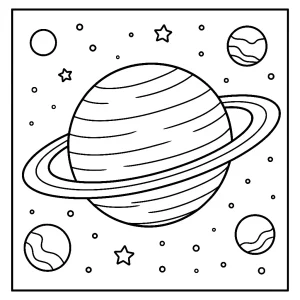
If a child encounters a bubble with the word “Download,” remember: each sheet is completely free. Thanks to this, regardless of budget, you can print endless pattern combinations and create albums full of stellar landscapes. Coloring becomes a unique tool for building an educational library. While digital apps are popular, paper allows, of course, for screen-free time and eye rest.
Firstly, coloring planets develops fine motor skills. Small hand movements, over a few minutes, strengthen the muscles responsible for later writing. Secondly, coloring pages teach concentration – children focus on outlines to stay within the lines. Thirdly, general knowledge grows. When a parent explains that Saturn shows a different ring angle during the winter solstice, the young artist remembers the relationship between the season and axial tilt. Meanwhile, shared conversation fosters closeness, strengthening the relationship. Ultimately, each completed work increases a sense of agency, which, incidentally, translates into motivation for more challenging school tasks.
First, prepare printed sheets and arrange crayons in rainbow order. Encourage the child to match colors to surface temperatures. Mercury – shades of gray, while Venus – yellows and oranges. Next, play “Astronaut Quiz”: each well-colored planet earns a point that can be exchanged for a sticker with a cosmic symbol. Thirdly, try orbit simulations. Cut out the planets, glue them onto cardboard, and hang them on a string. This way, you create a mobile solar system to hang above a desk.
From time to time, organize an “observer’s night.” After coloring, look at the sky through binoculars. The child will quickly discover that the brightest point is Venus. In short, theory will immediately become practice. Meanwhile, you can keep a journal. Each evening, paste a cut-out, colored planet and describe what you saw. Such a memory chronicle is motivating and reinforces the habit of regular observations.
Now that you know how much joy coloring brings, discover the galaxy of colors with our free printable coloring pages – download, print, and start your cosmic adventure today!


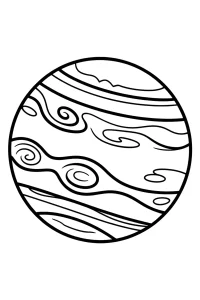





You are browsing the Planets category. Looking for more? See other coloring pages in Space or browse all printable coloring pages.