Ants - Printable coloring pages

Ants – Printable Coloring Pages for Curious Explorers

Is your child fascinated by the natural world, especially the tiny creatures living beneath our feet? Ant coloring pages are a captivating way to combine learning with fun! Let the little ones discover the amazing world of insects that, although small, play a huge role in nature. These free printable coloring pages are a great opportunity to talk with your child about nature, ecology, and teamwork.

Why are ants so interesting to children?

Ants have fascinated humans for centuries with their extraordinary organization, perseverance, and way of life. For children, it’s something entirely new – tiny beings that can build complex anthills, work together in groups, and carry loads several times their weight. Coloring pages depicting ants in various situations – gathering food, building nests, or caring for the queen – stimulate imagination and curiosity about the world.

What can children learn by coloring ants?

Coloring not only calms and helps with concentration but also conveys important information in an accessible way. In the case of ants, children can learn about the hierarchy in an anthill, the differences between a worker, a soldier, and a queen, and how pheromones and scent trails work. Such educational coloring pages develop not only fine motor skills but also general knowledge.
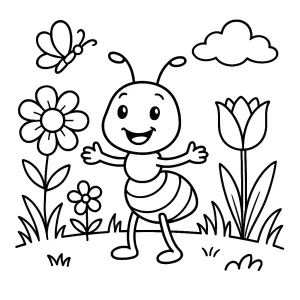
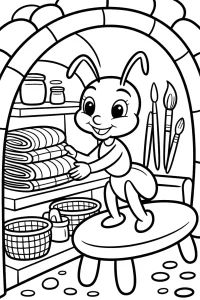
Download PDF smiling ant waving free printable coloring page

Interesting Facts About Ants That Will Surprise Not Only Children

Did you know that ants can create living bridges with their bodies to overcome obstacles? Or that some species “farm” aphids to drink their sweet secretion – honeydew? Moreover, an ant colony can number several million individuals and have its own “hospitals” where sick ants are treated by others!

Although ants are small, their brains are exceptionally efficient. Compared to their body size, their intelligence and cooperation skills impress even scientists. Interestingly, some ants can also “learn” and mimic the behaviors of their companions.

Thematic Lists Related to the World of Ants

  • Most Popular Ant Species in Europe: In our gardens, we most commonly find the red ant (Formica rufa), which builds impressive mounds from needles and twigs. The small, black Lasius niger – commonly known as the garden ant – is also popular. An interesting species is the pharaoh ant (Monomorium pharaonis), which likes to inhabit building interiors.
  • Social Insects – Ants, Bees, and Termites: All these insects live in organized communities with role divisions. Ants have workers, soldiers, and a queen – just like bees. Termites also create a caste system, although they are not closely related to ants. It’s a great topic for comparisons and discovering differences and similarities together.
  • Animals That Live Underground: Besides ants, moles, earthworms, shrews, and some lizards also live underground. This underground world is an amazing network of tunnels and burrows. Coloring pages can show how different creatures share this space without getting in each other’s way.
  • The Largest Anthills in the World: A record anthill was found in Argentina – it was over 6,000 kilometers long and contained millions of nests! Equally impressive are the forest anthills in Europe, which can reach over a meter in height and be inhabited by hundreds of thousands of ants.
  • Movies and Cartoons Featuring Ants: It’s worth watching the movie “Antz” with your child, which presents colony life from the perspective of a single ant. “A Bug’s Life” is a funny story about ants and grasshoppers, teaching courage and cooperation. Such productions help children identify with the characters and understand the value of community.
  • Sensory Organs in Insects: Ants don’t have ears but sense ground vibrations. They have very sensitive antennae, which they use to recognize smells, tastes, and touch. Their compound eyes consist of many lenses, but vision is not their strong suit – they rely more on smell and pheromones.
  • The Life Cycle of an Ant – From Egg to Adult Worker: It all starts with an egg, which can develop into a larva, then a pupa, and finally an adult ant. Depending on the type of larva and care, eggs can become workers, males, or queens. This process is great for illustrating in coloring pages step by step.
  • Differences Between an Ant and a Termite: Although they look similar, termites belong to a different order of insects. They have straight antennae, and their abdomen is not constricted like that of ants. Interestingly, winged ants and termites often appear at the same time, which can confuse observers.
  • Ants in Culture – Symbols of Work and Organization: Since ancient times, ants have been symbols of diligence and order. In Aesop’s or La Fontaine’s fables, they appear as examples of prudence and hard work. Today, they are used in logos or comparisons – e.g., “work like an ant.”
  • The Strangest Ant Behaviors in the World: Some species “enslave” other ants and force them to work. Others create rafts from their bodies to float across water. Still, others can explode, protecting the colony! The world of ants is full of surprising and extraordinary survival strategies.

What Benefits Does Coloring Ants Bring to Children?

Ant-themed coloring pages support the development of fine motor skills, help practice patience, and teach concentration. With realistic illustrations, children better remember the appearance of ants, their body parts, and how they move. It’s also a great opportunity to talk about nature and the importance of every creature in the ecosystem. Additionally, children learn that even the smallest organism can have a huge impact – both on its environment and on other beings.

Ideas for Fun with Ant Coloring Pages

After coloring the ants, you can set up a mini-exhibition on the wall or fridge. An interesting idea is to create your own “anthill” out of paper – the child can draw underground tunnels and place the colored ant figures there. Another option is to organize a “find the queen” game – the child colors many similar ants, but only one has a crown! You can also create a story: “What do ants do when no one is watching?” – and illustrate it with coloring pages.

Free Printable Coloring Pages – Education and Fun in One

All our ant coloring pages are completely free and ready to print at home. This way, you can quickly and easily provide your child with creative entertainment – without leaving home and without purchasing materials. All you need is a few crayons and a sheet of paper to start the adventure with this fascinating world of insects.

Discover the joy of coloring with our free designs – download now and take your child to a microscopic world full of movement, organization, and amazing stories!
You are browsing the Ants category. Looking for more? See other coloring pages in Animals or browse all printable coloring pages.