

How to Choose a Coloring Page for Your Child’s Age: A Parent’s Guide

Will every coloring page work well for every child? Not necessarily. A toddler who is just learning how to hold a crayon needs completely different pictures than an older child who enjoys details, mandalas, or more complex scenes. Choosing the right coloring page can make a huge difference — between frustration and real joy in coloring.
A well-matched coloring page supports hand development, focus, patience, and imagination. It helps a child practice precision without making the task feel too difficult. As a result, coloring becomes a calm activity that children are happy to return to.
This guide will help you choose pictures that match your child’s age, abilities, and interests. It is useful for parents, caregivers, preschool teachers, and anyone looking for simple printable materials for activities with children.
Why does a child’s age matter when choosing a coloring page?
A coloring page may look simple, but for a child, it is a developmental task. It requires holding a crayon, controlling pressure, recognizing shapes, and planning hand movements. For a two-year-old, a large outline of a cat can be a real challenge. For an eight-year-old, the same picture may feel too easy.
It is not only about the subject of the picture. The number of details, thickness of the outlines, size of the areas to color, and the level of independence required all matter.
A coloring page that is too difficult can discourage a child, because the feeling of “I can’t do it” may appear very quickly. A coloring page that is too easy is not always the best choice either, especially for older children who need a sense of challenge and achievement.
The best coloring page is one that is just one small step beyond the child’s current skills. It does not overwhelm them, but it encourages them to try. It allows mistakes and still leaves room to enjoy the final result.
Quick overview: coloring pages by child’s age
Don’t have time to read the whole article? Use this table as a quick guide.
| Age | Coloring page features | Example themes |
|---|---|---|
| 1–2 years | Very large areas, thick outlines, 1 main element per page | Animals, fruit, simple shapes |
| 3–4 years | A few elements, clear boundaries, familiar themes | House, teddy bear, vehicles, balloon |
| 5–6 years | Simple scenes with a background, more details, room for conversation | Forest, farm, space, fairy-tale characters |
| 7–9 years | Details, thinner lines, different difficulty levels | Mandalas, sports, nature, themed scenes |
| 10+ years | More complex designs, stress-relief coloring pages, personal interpretation | Landscapes, fantasy, technical vehicles, geometric patterns |
Coloring pages for children aged 1–2: first attempts with crayons
The youngest children do not color “inside the lines” yet. That is completely normal. At this stage, the most important things are discovering the crayon, seeing the mark it leaves on paper, and enjoying the movement itself.
For children aged 1–2, it is best to choose very simple pictures. They should have large elements, strong outlines, and plenty of empty space. Single animals, fruit, vehicles, or simple shapes are good choices.


What coloring pages should you choose for the youngest children?
Focus on simplicity. One main object on the page is enough. The background should not distract the child.
- Choose large pictures with thick outlines.
- Avoid small details and complicated scenes.
- Print coloring pages on individual A4 sheets.
- Let your child color outside the lines — it is part of learning.
- Treat the activity as an exercise in freedom, not accuracy.
At this stage, simple printable animal coloring pages work very well. A child can recognize a dog, cat, rabbit, or fish while also learning animal names and sounds.
Do not correct your child too forcefully. If the sky is green and the cat has blue paws, it is still valuable work. For a toddler, the process matters more than a realistic result.
Coloring pages for children aged 3–4: simple shapes and first precision
Children aged 3–4 usually have better control over hand movements. They begin to understand that they can color a specific part of a picture. However, they still need large areas and clear boundaries.
This is a good time for coloring pages with a few elements. It may be an animal on grass, a car on a road, a flower in a pot, or the moon with stars. The scene should be easy to understand at first glance.
What should you choose for a three- or four-year-old?
A coloring page for this age should be simple, but not boring. Children enjoy recognizing familiar things, so everyday themes work well. A house, teddy bear, balloon, apple, or bus will usually be more engaging than an abstract pattern.
At this age, you can gently encourage your child to choose colors. However, you do not need to expect accuracy. It is better to ask, “Which color will you choose for the balloon?” than to say, “Don’t go outside the lines.”
Categories such as printable vehicle coloring pages are a good choice, because cars, trains, and airplanes have clear shapes. Children recognize them easily and often enjoy talking about them.
A good sign is the child’s engagement. If your child asks for another sheet on their own, the difficulty level is probably well matched.


Coloring pages for children aged 5–6: more details and themed scenes
Children aged 5–6 can often focus for longer. They begin to color more carefully, plan their work, and enjoy themes that match their interests. This is a great time for scenes with several characters or a simple story in the background.
Watch not only the child’s age, but also their patience. Some five-year-olds love details, while others still prefer large, calm pictures — and both approaches are completely normal.
Coloring pages for preschoolers step by step
A preschooler can already use coloring pages that include a background. A forest, garden, playground, space scene, or farm creates a context for conversation. Thanks to this, coloring is not only hand practice, but also an opportunity to build vocabulary.
- First, show your child the whole coloring page and ask what they see.
- Ask them to choose one element to start with.
- Encourage them to pick 2–3 colors before they begin.
- After a few minutes, allow a break if the child needs one.
- At the end, talk about the finished work — without judging mistakes.
For this age group, printable fantasy coloring pages work especially well. Dragons, fairies, robots, and unicorns stimulate the imagination and allow children to use unusual colors.
You can also introduce simple tasks: “Color all the stars yellow” or “Find three small flowers.” These activities support observation skills and help prepare children for school tasks.
Coloring pages for children aged 7–9: accuracy, patience, and personal style
Early school-age children often want their work to look “nice.” They compare their pictures with their peers’ work and start paying more attention to details. This is the moment when it is worth giving them more choice and more freedom.
Coloring pages for children at this age can include more elements, thinner lines, and a more developed composition. Sports scenes, space themes, nature, holiday pictures, and mandalas for children all work well.
How to choose the right difficulty level for a school-age child?
A school-age child can already decide whether they prefer a simple coloring page for quick relaxation or a more challenging picture for longer work. It is worth having several difficulty levels available. This way, the child will not feel that they always have to do the same kind of activity.
If impatience appears after only a few minutes, the coloring page may be too detailed. If the child finishes it very quickly and says it was “for little kids,” it is worth offering a more demanding design.


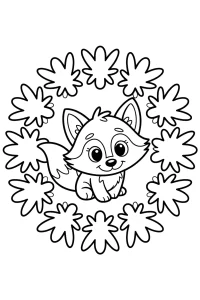


Pictures with repeating patterns are a good choice for older children. They teach rhythm, accuracy, and patience. You can choose printable mandalas for children, especially when your child needs a calm activity after coming home from school.
Good to know: coloring repeating patterns can feel like a small break for an overloaded mind. When the hand makes calm, rhythmic movements, it can be easier to organize emotions after an intense day — this is one reason why teachers often use mandalas at the end of a lesson.
Coloring pages for children aged 10+: personal interpretation and a moment to breathe
Older children often no longer want coloring pages that feel too childish. They need themes that look more mature and allow personal interpretation. These may include complex mandalas, detailed landscapes, animals with anatomical details, fantasy scenes, or technical vehicles.
At this age, coloring has a different purpose than before. It is no longer only about hand practice — it is mainly a way to relax, take a break from screens, and focus calmly after an intense school day.
Stress-relief coloring pages for older children
Stress-relief coloring pages for older children should include more details, but they should not feel chaotic. The best designs give a sense of order. The child can then decide whether to use many colors or limit the palette to a few calm shades.
For students at this age, themed coloring pages matched to their interests also work very well. If a child is fascinated by space, choose rockets and planets. If they enjoy sports, dynamic scenes with players will be a good option.
It is also worth encouraging the child to add their own elements to the coloring page or write a short story inspired by the picture. At this stage, a coloring page often becomes a starting point for personal creativity, not just a task to fill in.
At the end, it is always worth asking: “Do you want something simple for a short break, or something harder for longer coloring?” This kind of question gives the child control over the activity and reduces resistance before starting.
How to choose a coloring page for your child’s age step by step
You do not need to know specialist developmental standards to choose a good coloring page. Simple observation is enough. Pay attention to how your child holds a crayon, how long they can work, and whether they enjoy details.
Here is a practical framework that will help you make a quick decision — at home, in preschool, or in the classroom.
- Check the size of the elements. The younger the child, the larger the coloring areas should be.
- Look at the number of details. For toddlers, choose one main theme. For older children, choose a scene with a background.
- Match the theme to the child’s interests. Animals, vehicles, space, or fairy-tale characters increase motivation.
- Pay attention to the working time. A good coloring page should not feel tiring after the first two minutes.
- Give the child a choice. Offer two or three sheets and let them decide what they want to color.
This framework works especially well with groups. A teacher can prepare several versions of the same theme. Younger or less confident children can choose a simpler picture, while more advanced children can pick a more detailed version.
If you are looking for more inspiration for working with children, visit the guides and articles about coloring pages for children. You will find creative activity ideas that can be used at home and in education.
Common mistakes when choosing coloring pages
The most common mistake is choosing a picture through adult eyes. A parent sees a beautiful, detailed illustration and assumes the child will love it. In reality, a young child may feel overwhelmed after a short time and abandon the activity.
The second mistake is expecting accuracy too early. Coloring outside the lines in young children does not mean a lack of care — it means the hand and eye are still learning to work together. This is a completely natural stage.
When is a coloring page too difficult?
A coloring page may be too difficult if a child quickly gives up, gets upset, or says they “can’t do it.” In that case, it is worth offering a simpler picture without commenting on failure. You can calmly say: “Let’s try one with bigger spaces.”
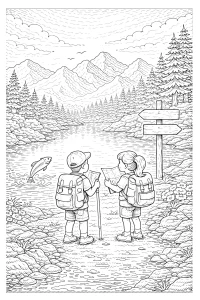
A coloring page that is too difficult usually has too many small elements, thin outlines, or a dense background. It may look attractive to an adult, but for a child it can feel like an endless task.


When is a coloring page too easy?
A coloring page that is too easy can also be discouraging. An older child may feel that they are being treated like a little kid. If the picture is finished in one minute and brings no satisfaction, it is worth increasing the difficulty level.
A good solution is to add a creative task. Even a simple picture can be expanded with a question such as: “Can you draw the background?” or “What story does this character have?” Then the coloring page becomes a starting point for the child’s own creativity.
How to use coloring pages at home, in preschool, and at school
At home, a coloring page can be a calm activity after preschool, before bedtime, or whenever a child needs to settle down. It does not have to last long — even 10 minutes of coloring can be a valuable break from screens.
In preschool, coloring pages help reinforce lesson themes. After talking about animals, children can color a lion, turtle, or stork. After a lesson about autumn, leaves, trees, and mushrooms are a good fit.
At school, coloring pages can work as supplementary materials. They are useful in language lessons, nature lessons, art, and early education. Children can label parts of the picture, count objects, or create short descriptions.
The best results come from combining coloring with conversation. Ask your child what is happening in the picture, which colors they chose, and why. This turns a simple printable sheet into an exercise in language, emotions, and imagination.
See also
- Articles with ideas for coloring pages and creative activities with children
- Free printable coloring pages for children in different categories
Choose a coloring page that truly fits your child
Choosing a coloring page does not have to be difficult. Just look at your child’s age, abilities, and interests. The most important thing is that the picture encourages action instead of creating pressure.
Simple designs for toddlers, more detailed ones for older children — and always a little freedom, so the child feels that the work truly belongs to them.
Explore free printable coloring pages matched to different ages and choose a picture that best fits today’s activity. You can also visit our other articles and guides — you will find even more ideas for creative activities with children.


